
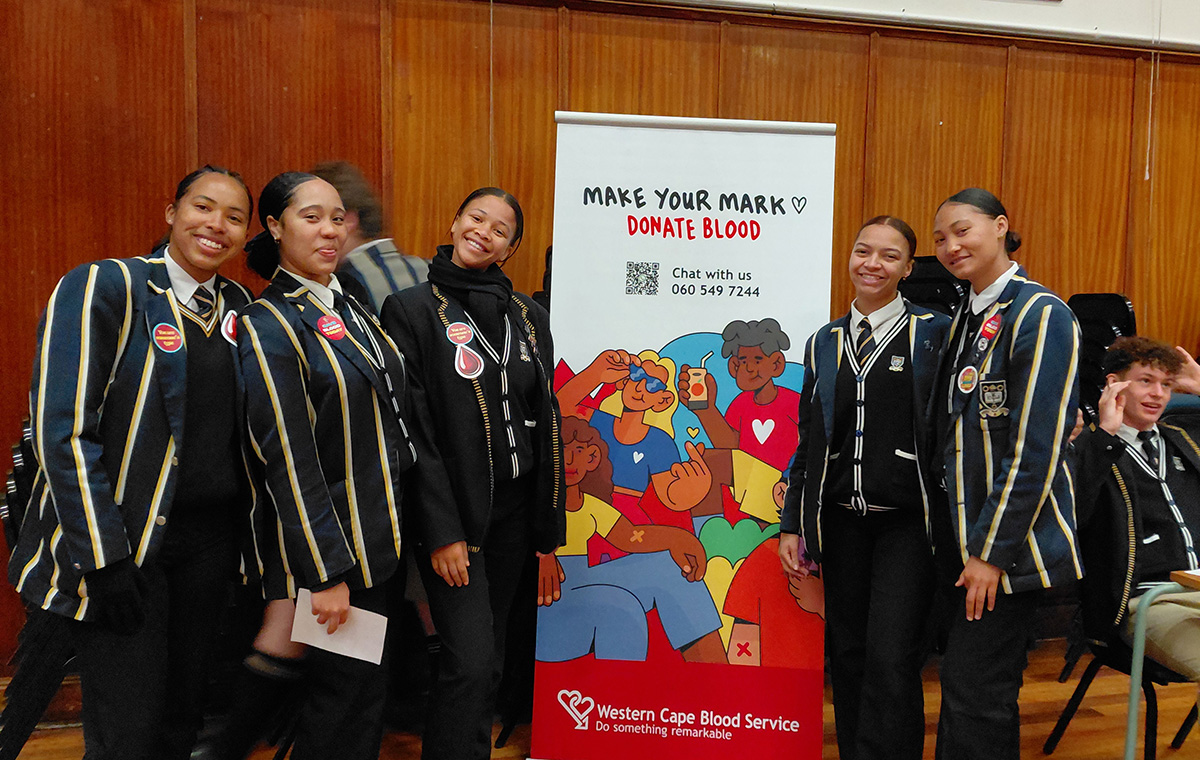
For one week each year, schools across the Western Cape unite to become warriors in saving lives. From 27 to 31 July 2026, the Week of Warriors campaign gave learners the opportunity to donate blood at their schools, many for the first time, while learning more about the important role they can play in helping patients who need blood.
The campaign is an important part of our youth donor strategy and supports our goal of growing the youth donor base. It also allows us to speak directly to young people about the ongoing need for blood donors and to introduce blood donation in an environment they know and are comfortable in. For many learners, a school blood donation clinic may be the first time they consider becoming a donor.
This year, 16 schools took part in Week of Warriors, compared to 10 schools last year. The campaign set a target of getting 1,000 donors through the doors. By the end of the week, 927 young people tried to donate blood, including 311 first-time donors, and 654 units of blood were collected.
While the 1 000-donor target was not quite reached, the response was encouraging. More schools participated, hundreds of young people donated and, most importantly, 311 learners took their first step towards becoming regular blood donors.
The participating schools were Apex High School, Bergvliet High School, Bridge House School, Curro Century City, DF Akademie, George High School, Hoërskool Jan van Riebeeck, Hoërskool Outeniqua, HTS Drostdy, Knysna High School, Mondeor Eco School of Skills, Parel Vallei High School, Hoërskool President, The Settlers High School, Westerford High School and Worcester Gymnasium.
Each school brought its own energy to the campaign. For some, blood donation is already a familiar part of the school calendar. For others, Week of Warriors provided an opportunity to introduce learners to blood donation.
That is one of the strengths of taking blood donation into schools. Learners are surrounded by friends, teachers and classmates, making it easier to ask questions, learn from others and decide whether they are ready to donate.
A learner may arrive at the clinic because a friend encouraged them to go. Another may have seen the campaign promoted at school and decided to find out more. Someone else may already have donated before and returned because they know the difference their donation can make. Whatever the reason, every donor contributes to the same goal, helping ensure that blood is available for patients who need it.
These results remind us that school blood donation is not about a single clinic or campaign. When a school makes blood donation part of its culture, learners begin to see giving blood as a normal way of helping others.