

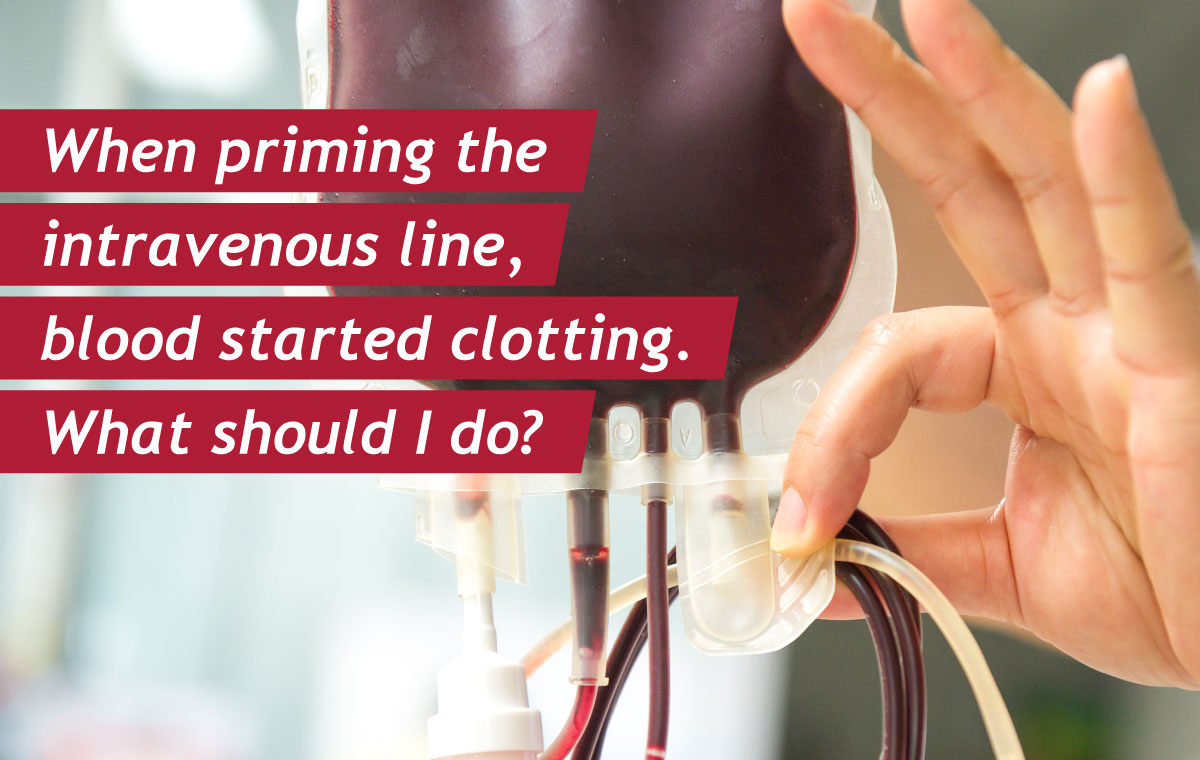
Before transfusion, ward staff must inspect the blood bag for clots. If you observe clotting, do not proceed with the transfusion. Remove the blood bag and keep the vein open with normal saline. Report the product complaint to the Blood Bank and return the bag, along with the blood administration set attached. The Blood Bank will issue a replacement blood bag to continue the transfusion while the product complaint investigation is underway.
Additionally, use only 0.9% normal saline to prime the line. Close all clamps, spike the saline bag, squeeze the drip chamber until the filter (170–240 µm mesh) is fully covered by fluid, and prime the remainder of the Y-tubing to remove all air. Ensure that the line is free of air bubbles, as bubbles may create turbulence and slow blood flow, increasing the risk of clot formation. Check for kinks in the administration set, as these can halt the flow. Fully open the clamp, as a partially opened clamp can also cause clots to form.
Do not add medications or other fluids to blood or blood products before or during a transfusion, as this can cause a reaction between the drug and anticoagulant or nutrient fluid in the blood. For example, dextrose solutions may cause lysis or aggregation of red cells in the administration set. Additional risks include bacterial contamination introduced by adding medications or other fluids, and the possibility that therapeutic drug levels may not be achieved if the blood is administered slowly.
The only fluids that can be given concurrently through the same intravenous line as a red cell transfusion are normal saline; calcium-free balanced salt solutions (e.g., Plasmalyte-L, Plasmalyte-B, Balsol, and modified Ringer’s lactate); 4% albumin; plasma protein fractions; and ABO-compatible plasma.
WCBS adheres to strict guidelines for visually inspecting blood products. As stipulated in the standards of practice for Blood Services, staff conduct routine visual checks for any abnormalities. Additionally, WCBS utilises state-of-the-art blood collection monitors and mixers to ensure that blood is adequately mixed with anticoagulant in the bag and to monitor blood flow. However, we occasionally find clots. We regularly monitor products rejected due to clots to identify trends and recurrences and to assess the effectiveness of corrective actions.
For more information about handling clots in blood bags, contact your closest Blood Bank.